
Red Clay Stain Removal for Carpet: The Huntsville Guide
Last updated: July 2026
A fresh red clay track costs you a quarter teaspoon of dish soap and some patience: let the clay dry completely, vacuum it out, then blot whatever's left with cool, soapy water on a white cloth. Handled that way, most clay never becomes a stain at all. Wipe it while it's wet, though, and you can make it permanent.
We pull red clay out of Huntsville carpets every week, in new builds in Hampton Cove and off gravel drives out toward Owens Cross Roads. This page is the exact routine we'd use in our own houses, in order, with measurements. It also covers the mistakes that turn a five-minute cleanup into a stain you live with, and the honest version of what a professional can and can't fix.
Why does North Alabama red clay stain carpet like nothing else?
The red in our dirt is iron oxide, the same mineral family that makes rust orange. Around Madison County it's ground so fine that it behaves less like soil and more like pigment. That single fact explains everything else on this page.
Dry, those particles sit on top of the carpet as crumbs and powder. They have almost no grip, which is why a vacuum pulls them out so easily. Add water and the picture flips: the clay turns into a thin slurry that slides down between the fibers, past where any rag can reach, all the way to the base of the pile.
Now add the carpet itself. Most subdivision carpet in Huntsville is nylon, and nylon takes color the way it does because the fiber has open sites that chemically grab dye at the mill. Those same sites grab iron oxide. So when you scrub wet clay across nylon, you're dyeing the carpet, not cleaning it.
Heat makes every part of that worse. Hot water speeds the bond, which is why the one stain in the house that never fully left is almost always the one somebody attacked with hot water and a brush. After years of these, the pattern never changes: the stains that come out easiest are the ones nobody touched.
What is the dry-first rule?
The dry-first rule: never touch wet clay. Don't wipe it, don't blot it, don't dampen it. Walk away and let it dry completely, even if that takes a few hours. Then vacuum. This one habit prevents more permanent clay stains than everything else on this page combined.
It feels wrong. Every instinct says grab a wet rag before the stain "sets in." With clay, the opposite is true: dry clay lets go of carpet, and wet clay bonds to it. The wet rag is the thing that sets it.
So block the spot instead. Turn a laundry basket upside down over it so the kids and the dog stay off, aim a fan at it if you're in a hurry, and come back when it's crumbly and pale. A fan is fine; heat is not, so leave the hair dryer in the drawer. Most fresh tracks handled this way disappear with the vacuum alone.
How do you get a red clay stain out of carpet, step by step?
You need five things: clear dish soap, two white cloths or plain white paper towels, a spoon, a vacuum, and cool water. Nothing from the cleaning aisle. Work the steps in this order and don't skip ahead.
Let it dry completely
Dry clay looks lighter, feels crumbly, and powders when you poke it. If it still smears, it isn't ready. This step is boring and it is also the whole ballgame.
Vacuum like you mean it
Slow passes from four different directions, then the crevice tool along the edges of the spot. Keep going until a white cloth pressed onto the area picks up no red dust. Most of the clay leaves your house right here.
Break up the crust and vacuum again
Use the back of a spoon to gently crumble anything still caked on the fiber tips. Don't dig into the pile. Vacuum the crumbs, and check the spot — plenty of "stains" are already gone at this point.
Mix the solution
A quarter teaspoon of clear dish soap in two cups of cool water. Clear matters: orange and blue soaps carry their own dye. More soap is not better, either. Leftover residue attracts new dirt and makes the spot reappear gray in a month.
Blot, never rub
Dampen a white cloth in the solution and press it onto the stain, starting at the outside edge and working toward the center so you don't spread it. Lift, refold to a clean face, press again. Red transferring onto the cloth means it's working.
Repeat in cycles
Press the spot dry with your second white cloth, then go back to the soapy blot. Short cycles, a few minutes each. Stop when a dry white cloth pressed down hard comes up with no red on it.
Rinse and dry it fast
Blot once more with plain cool water to lift the soap out. Then stack white towels on the spot, weight them with a heavy pot for an hour, and finish with a fan. In our humidity you want that spot dry quickly, for the reason below.
One more thing worth knowing: wicking. If a faint ring shows up the next morning, pigment that traveled down to the base wicked back up the fiber as the spot dried. Don't panic. Repeat the blot-rinse-dry cycle. The second round is almost always shallower and faster than the first.
What should you never do to a red clay stain?
Keep hot water far away from clay. Heat locks iron-oxide pigment in the way a dryer sets a shirt stain. Cool water lifts clay nearly as well and risks nothing. Once a clay stain has been heat-set it is much harder to move, so let us test it before anyone scrubs.
Never scrub. Scrubbing grinds pigment down into the fiber, pushes the edge of the stain wider, and fuzzes the pile so the spot looks rough even after the color is gone. Blotting pulls the stain up into the cloth. Scrubbing drives it down into the carpet.
Never use colored or printed towels. A damp towel plus soap can release the towel's own dye into your carpet. We've been called out to fix a blue stain that started life as a red one. White cloth, white paper towels, nothing else.
Be careful with hardware-store foams and "oxy" sprays. Some are strong enough to lighten the carpet's own dye, which trades a red spot for a pale ghost spot that cleaning can't undo. If you're set on trying a product, test it somewhere hidden, like inside a closet, and wait a full day. Honestly, on clay, the dish-soap method beats most of what's on that shelf.
Don't flood it. A puddle soaks down below the fiber, carries pigment with it, and then feeds it back up the fiber for days. Damp cloth, light passes, patience.
How do you keep red clay out of your carpet?
Most Huntsville-area homes sit on a slab a few inches above the yard, so the clay is always one wet afternoon away from the door. You won't keep every particle out. You can keep out most of it with three cheap habits.
Set up the garage entry properly. In a subdivision, the garage door is the real front door. That's where the shoes, the cleats, and the dog come in. Put a stiff bristle mat on the garage slab outside the interior door and a washable absorbent mat just inside it. The bristle mat knocks off the crumbs, the inside mat catches the damp residue, and the carpet four feet in stops taking the hit. Wash the inside mat before it looks dirty, because by then it's full.
Go shoes-off, even imperfectly. Nobody enforces this with houseguests, and that's fine. If the family takes shoes off at the door most of the time, the high-traffic lanes last years longer between cleanings. The first stretch of carpet inside the garage door takes most of the abuse in every house we clean.
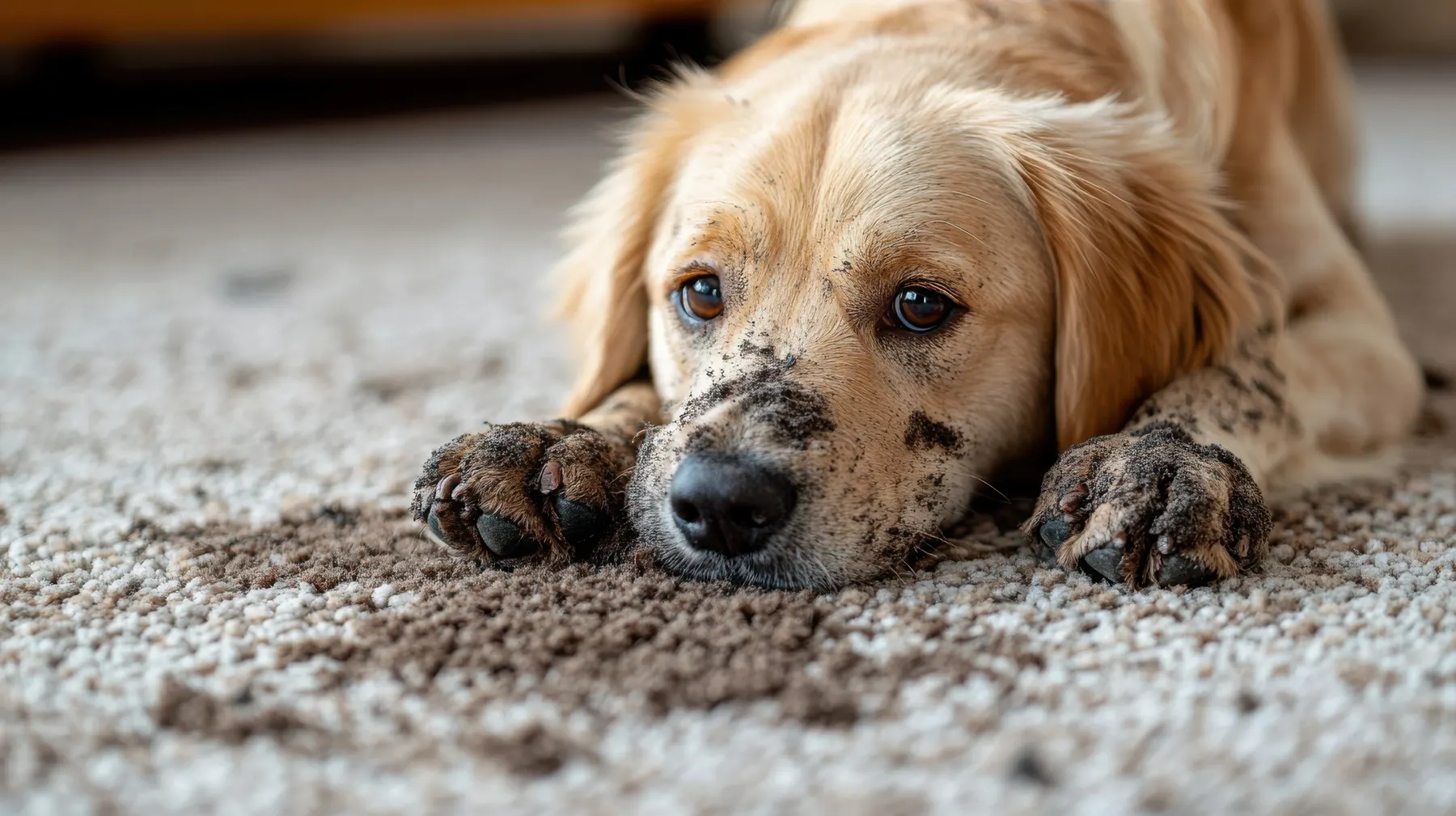
Towel the dog at the door. Keep one dedicated dark towel by the entry — dark, because clay ruins white towels for anything else. After rain, wipe paws while the dog is still on hard flooring, before the victory lap down the hallway. A golden retriever with wet clay on four paws can print a forty-foot stain in about six seconds; we've seen the hallway to prove it. And if the dog is bringing in more than clay, that's a different problem with a different fix — our pet stain and odor page covers it.
Some neighborhoods have it worse than others, and it's worth knowing if yours is one. Hampton Cove still has active construction phases, and every graded bare lot sheds clay onto the streets, where it rides your tires into the garage and your shoes into the house. Out in Owens Cross Roads, gravel and unpaved drives keep a steady supply of clay dust in dry weeks and wet ruts after storms, and our customers there fight it harder than anyone. And in Clift Farm, new sod is the culprit: the seams between sod rolls stay bare clay through the first growing season, and every sprinkler cycle splashes it onto the sidewalk, then the shoes, then the carpet. Keep the mats going until the grass knits together.
When should you hand a clay stain to a professional?
Three situations, in our experience. First, set-in older stains: anything that's been walked on for weeks, scrubbed, or hit with hot water. Household soap works on loose pigment; it cannot reach pigment that has bonded to the fiber, and repeated DIY rounds on a bonded stain just wear out the carpet around it.
Second, wool. Wool carpet and wool rugs are a different animal from nylon: the wrong cleaner or too much agitation damages both the fiber and its dye, and there's no undo button. If clay lands on a wool rug, stop at the vacuum step and call. We clean wool rugs right in your home, so the rug never has to leave your house.
Third, size. Blotting a two-inch spot is a chore. Blotting a hallway that got printed end to end, or a flight of stairs, or the reddish tint spreading from a back door, is a lost weekend that still won't match professional results.
Here's what we actually do differently, since "professional products" is a non-answer. We identify clay as an iron-based pigment stain and treat it with spotting agents made for exactly that, not an all-purpose spray. We agitate in a controlled way that lifts pigment instead of grinding it. We rinse and pull the residue out with our low-moisture process, which matters more on clay than on almost any other stain, because a spot that stays wet for hours will wick pigment back up as a ring. And the carpet is dry in about an hour, so the pigment has no time to travel.
Now the honest part. A fresh, dried clay track should come out completely. Expect 100% and hold us to it. Older set-in stains mostly come all the way out too, but some only fade instead of vanishing, and you're left with a faint tan shadow you'd have to know to look for. Light nylon plus hot water plus scrubbing is the toughest combination we see. We test a spot first, and if we think a stain will fade rather than vanish, you'll hear it from us before we start, not after. Love the clean or it's free applies either way.
What do Huntsville homeowners ask us about red clay?
How do you get red clay stains out of carpet?
Let it dry all the way, no matter how bad it looks. Vacuum slowly from several directions until no more red powder comes up. Then mix a quarter teaspoon of clear dish soap into two cups of cool water, dampen a white cloth, and blot from the edge of the stain toward the middle. Press dry with a second white cloth and repeat until no red transfers. Finish with a plain-water blot and dry the spot fast.
Why does red clay stain carpet permanently?
The red color is iron oxide, the same mineral family as rust, ground into particles far finer than ordinary dirt. Wet, those particles slip down between carpet fibers, and nylon grabs iron oxide almost the way it grabs dye at the mill. Scrubbing and hot water push the pigment in and lock it there. That's why a stain wiped while wet can be permanent, while the same clay, left alone to dry, vacuums right out.
Does vinegar remove red clay?
Mostly, no. Vinegar earns its keep on alkaline residues and some food spills, but red clay is a pigment problem, and a mild acid does not dissolve iron oxide. Worse, pouring any liquid on fresh clay wets it and carries the pigment deeper into the fiber. Skip the vinegar. Let the clay dry, vacuum it out, and use the dish-soap method. Vinegar won't wreck your carpet, but on clay it mostly buys you a damp spot that's still red.
Can professionals remove old red clay stains?
Usually, yes. Fresh and recent clay comes out completely on most carpets. Older stains that were scrubbed, hit with hot water, or walked on for months are tougher, and on light nylon some of those fade instead of vanishing. We test a spot first and tell you exactly what to expect before we start, and every job is backed by our guarantee: love the clean or it's free.
If the clay has already won, carpet cleaning runs $109 for three rooms, and clay spotting is part of the job, not an add-on.
Carpet you can walk on in about an hour.
3 rooms for $109 · Love the clean or it's free.