
Pet stains and odor: first-hour first aid, then the real fix
Last updated: July 2026
Here's the short version: a fresh accident, blotted fast with cool water, usually comes out completely for free. An old one that soaked in deep usually doesn't. This guide covers what actually works at home and where the line sits. Past that line, our protein and enzyme treatment starts at $30 a room — with pet odor removal 100% guaranteed.
We treat pet accidents in Huntsville homes every week, so we have no reason to sugarcoat any of this. Some of what the internet recommends works. A lot of it wastes your Saturday and sets the stain while you scrub. Below is what we'd tell a neighbor, step by step.
- Fresh accident: blot hard with dry towels, dilute with cool water, blot again, then weight the spot with dry towels overnight.
- Never scrub and never use hot water — heat sets urine proteins the way it sets blood on a shirt.
- Enzyme cleaners work only when you pour enough to soak as deep as the urine went and keep the spot damp for hours.
- Repeat accidents in one spot, anything wool, or odor that survives two proper enzyme rounds sits deeper than store products reach — that's when to call us. Our protein and enzyme treatment reaches it, and it's 100% guaranteed.
Why is pet urine harder than other stains?
Because it's three problems wearing one disguise. There's the visible stain in the fiber, the bacteria that make it smell right now, and the protein residue it leaves behind deep in the carpet that makes it smell later. Coffee is one problem. Urine is all three, and every remedy below fixes some of them and not others.
Keep that in mind when a product "works" for a week and the smell creeps back. You solved problem one or two. Problem three is still down there, waiting on the weather. The sofa runs on the same logic, by the way: urine soaks into cushion foam just like it soaks down through carpet.
What should you do the second you find a fresh accident?
Move fast, because speed beats any product you own. Urine sitting near the surface is a five-minute fix. Urine that soaks down deep is a different job entirely, so all you're doing for the first ten minutes is pulling the liquid out before gravity wins.
Blot hard with dry towels
Fold a plain white towel, press it into the spot, and stand on it with your full weight. Move to a dry section and repeat until the towel comes up barely damp.
Pour on a little cool water
Half a cup or so, just enough to dilute what's left in the fiber. Cool only. Warm water sets the proteins in urine the way it sets blood on a shirt.
Blot again
Same drill: press, stand, swap for dry towels. You're lifting the diluted urine back out. A wet/dry vac, if you own one, does this step better than towels ever will.
Weight it overnight
Stack dry towels on the spot and set something heavy on top, like a cast-iron skillet or a few hardback books. The towels keep wicking moisture up out of the carpet while you sleep.
Three don'ts while you're at it. Don't scrub. Scrubbing frays the fiber and pushes urine sideways into clean carpet. Don't use hot water. Don't use a dyed towel, because dye transfers into a damp spot and now you have two stains.
One extra step if the accident landed on an area rug instead of carpet: slide dry towels underneath the rug before you pour any water, and swap them out as they dampen. That protects the floor below and pulls urine out from both directions at once.
Do those four steps within the hour and most fresh accidents never become stains at all.
Do enzyme cleaners actually work?
Yes, and they're the one product on the store shelf that does what the label promises. Enzyme cleaners, sometimes labeled "bio-enzymatic," digest urine compounds instead of covering them with perfume. When a customer tells us an enzyme cleaner failed, it's almost never the bottle. It's the application.
Two rules decide the outcome. First, the cleaner has to reach every fiber the urine reached, and urine travels down. If the dog left a cup of urine, a light misting treats the top tenth of the problem. Pour enough to soak all the way down — roughly as much cleaner as there was accident.
Second, enzymes only work while damp, and they work slowly. Cover the treated spot with plastic wrap or a damp towel and leave it alone for several hours, longer if the label asks for it. Then blot the area dry the same way you'd handle a fresh accident.
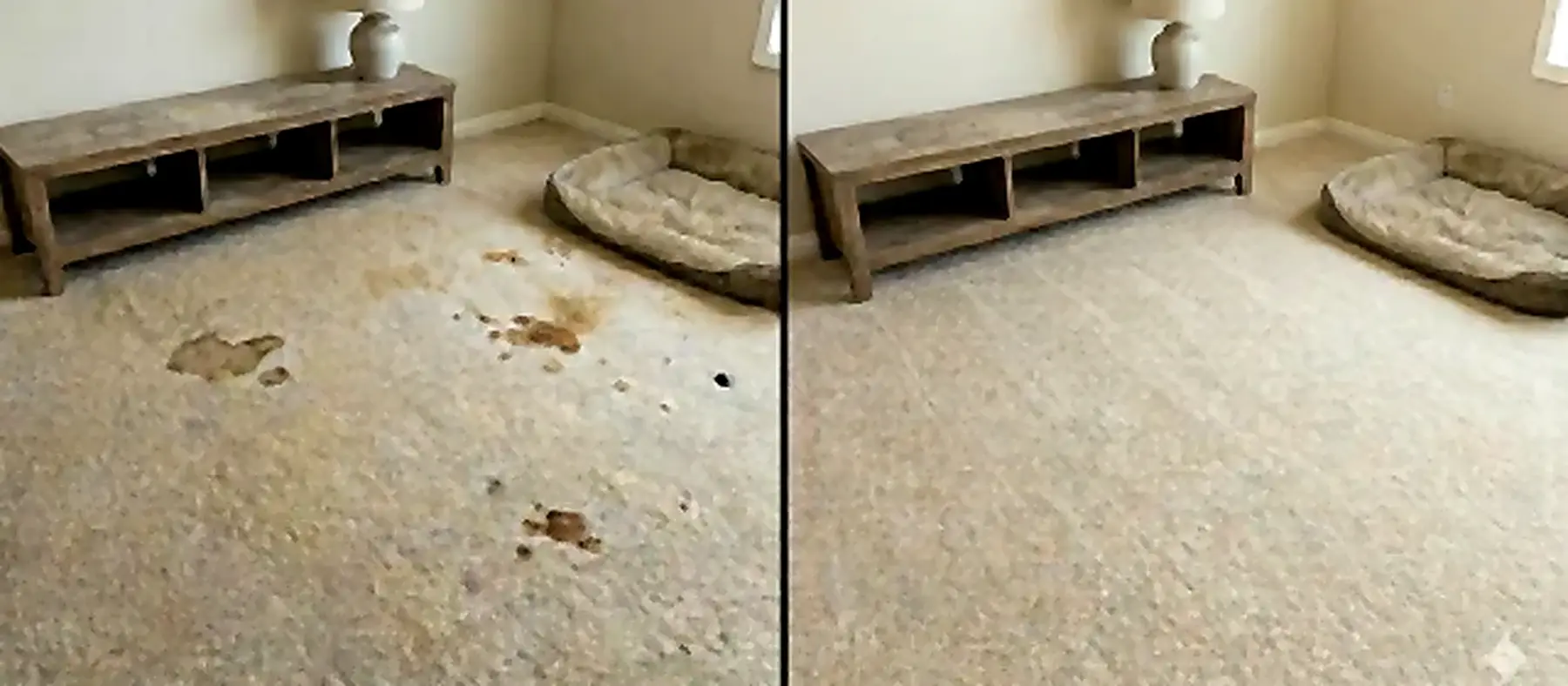
For a fresh, single accident, a store enzyme cleaner can finish the job: use more of it than feels reasonable and give it the whole afternoon. Anything older, or a spot that has been hit more than once, needs commercial-strength product applied all the way down to where the urine went — that's our treatment, and it's 100% guaranteed.
What can vinegar and baking soda actually do?
They're the internet's favorite answer, so let's be precise about what they earn. White vinegar diluted half-and-half with water can neutralize mild odor near the surface, and it's a fine rinse on a small fresh accident. Baking soda sprinkled on afterward absorbs some of what lingers in the fiber. For a puppy dribble on synthetic carpet, that pairing is often plenty.
What the pairing cannot do is reach urine that soaked down deep. Dried urine leaves residue bound far below the surface, and vinegar poured from above never gets to it at any useful strength. Surface odor, yes. The deep residue that brings the smell back every summer, no.
Two cautions from experience. Vacuum every bit of baking soda back out, because powder left in the pile cakes at the base of the fiber and dulls the carpet. And if you plan to follow up with an enzyme cleaner, rinse the vinegar out first — enzymes struggle to work in a freshly acidic spot.
How do you find old stains you can't see?
Invest in a UV blacklight flashlight. They run about $15–20 online, and it's the same tool our technicians sweep with on every pet job. Look for one labeled 365 nanometers — that wavelength makes dried urine glow while the rest of the room stays dark.
Here's how it works: as urine dries, the water evaporates but phosphorus and salts stay bonded in the fiber. Under UV light those compounds fluoresce — a pale yellow-green glow — even years after the accident, long after the spot went invisible in daylight.
Wait for dark, close the blinds, and sweep the light slowly about a foot above the carpet. Check edges, corners, and behind furniture first; pets prefer spots where they won't be interrupted, which is why the middle of the room is usually clean and the corner behind the recliner usually isn't. Drop a sticky note on every glow so you can treat them all at once.
Why does the odor come back every August?
Dried urine residue is nearly odorless while it stays dry, and Huntsville hands it a humid wake-up call every summer. Moisture in the air reactivates it, which is why a carpet that smelled fine in April turns sour by August. When the smell fades in October, the problem didn't leave. The air just dried out. The full explanation, and how our protein and enzyme treatment ends the cycle for good, is on our pet stain and odor treatment page.
When should you put the spray bottle down?
Fresh accident? Use the steps above. But three situations are past what a store bottle can do, and knowing them saves you real money on products that were never going to win. Here they are, in the order we see them.
Repeat accidents in the same spot. Pets go back to the scent, and a spot that's been hit five times holds more urine than any surface treatment can reach. At that point the problem lives deeper than any spray bottle goes.
Anything wool. Wool reacts badly to urine's alkaline chemistry and to most store-bought cleaners. Dyes can bleed and fibers can brown from products that are harmless on nylon. On a wool rug or wool carpet, stop at blotting with cool water and call someone who handles wool for a living.
Odor that survives two proper enzyme rounds. If you saturated the spot thoroughly, kept it damp for hours, and ran the whole routine twice, whatever remains sits too deep for store products. A third bottle won't reach it either.
When you hit any of those, it's time for the professional version: our protein and enzyme treatment starts at $30 per room on top of the cleaning, uses commercial-strength product applied deep enough to actually finish the job, and pet odor removal is 100% guaranteed. And if the accident happened on the couch instead of the carpet, we handle that too — details are on our upholstery cleaning page. Either way, you'll have an exact written price before we touch a fiber.
Have a question we didn't cover?
What home remedy removes pet urine from carpet?
For a fresh accident: blot hard with dry towels, dilute with a half cup of cool water, blot again, then weight the spot with dry towels overnight. That pulls most of the urine out before it sets. For dried accidents, an enzyme cleaner from the pet aisle is the only home remedy that breaks urine down rather than covering it. Vinegar and baking soda help with mild surface odor but can't reach urine that has soaked down deep.
Do enzyme cleaners really work?
Yes, when they're used correctly, which is rare. The cleaner has to soak all the way down to wherever the urine went, and it has to stay damp for several hours to keep working. Most people mist the surface, wipe it up ten minutes later, and blame the bottle. Use roughly as much cleaner as there was urine, cover the spot to slow evaporation, and give it the full afternoon.
How do I find old pet stains?
Invest in a UV blacklight flashlight — about $15–20 online, and the same tool our technicians use on every pet job. Dried urine leaves phosphorus and salts bonded in the fiber, and under UV light they fluoresce a pale yellow-green, even years after the accident. Wait for dark, sweep the light slowly about a foot above the carpet, and mark every glowing spot with a sticky note. Check corners and behind furniture first — pets pick spots where they won't be interrupted.
When should I call a professional for a pet stain?
Three signs: the same spot has been hit multiple times, the carpet or rug is wool, or the odor is still there after two thorough enzyme treatments. All three mean the problem sits deeper than store products can reach. Our professional protein and enzyme treatment starts at $30 per room and pet odor removal is 100% guaranteed — and we'll tell you honestly whether a spot can be saved before we start.
Carpet you can walk on in about an hour.
3 rooms for $109 · Love the clean or it's free.